In the entire world of music production, no two terms are more frequently confused, misunderstood, or conflated than mixing and mastering.
Every single week, an independent artist emails me a single unmixed stereo WAV file containing buried vocals, clipping kick drums, and muddy synths, asking: “Hey Aamir, can you master this track and make it sound like Drake or The Weeknd?”
When I gently explain that mastering cannot separate an already-recorded vocal from an 808 bass, and that the song first requires a multitrack mixdown, they are often surprised. Many believe mastering is simply a magical button where an engineer runs a song through expensive analog gear and turns a bedroom demo into a platinum record.
Quora and Reddit threads are filled with the same recurring debate: “Can mastering fix my vocal levels? Is AI mastering good enough? Do I need both mixing and mastering, or can I just master my rough beat?”
The reality is that mixing and mastering are two completely separate disciplines requiring different mindsets, different monitoring environments, and completely different toolsets.
Mixing builds the house brick by brick. Mastering polishes the exterior, inspects the structural integrity, and ensures the building stands up against weather and earthquakes.
Here is the definitive guide to understanding exactly what happens during mixing versus mastering, how to know which service your track needs, and why skipping either step will cripple your song's potential on streaming platforms.
1. What is Mixing? The Art of Balancing Multitrack Chaos
Mixing is the intricate, creative, and technical process of taking all the individual audio tracks recorded in a DAW session—often 30 to 80 separate multitrack stems—and blending them into one cohesive, balanced stereo audio file.
When you finish recording a song, your session contains a chaotic collection of raw audio elements:
* 5 tracks of kick, snare, claps, and hi-hats.
* 2 tracks of 808 and sub-bass.
* 10 tracks of synths, guitars, pianos, and sound effects.
* 15 to 30 tracks of lead vocals, doubles, harmonies, adlibs, and background layers.
At this stage, the individual instruments are fighting for space. The bass is masking the kick drum, the lead vocal is buried under distorted electric guitars, and harsh room echoes are cluttering the stereo field.
The Mixing Workflow:
[30 to 80 Individual Multitrack Audio Stems]
      │
      ├──> Dynamic Processing (Compression, Gating, Transient Shaping)
      ├──> Frequency Carving (Subtractive & Additive Equalization)
      ├──> Spatial Placement (Panning, Stereo Width, Mid/Side balance)
      ├──> Time-Based Effects (Reverbs, Delays, Chorus, Flangers)
      ├──> Pitch & Timing Correction (Melodyne, Auto-Tune, Vocal Alignment)
      │
      ▼
[One Balanced, Cohesive 24-Bit Stereo WAV Mixdown]
What a Mixing Engineer Actually Does:
- Gain Staging and Level Balancing: Establishing relative volume faders so every instrument sits in its correct dynamic hierarchy.
- Frequency Carving (EQ): Removing low-end mud (200Hz–400Hz), cutting harsh vocal resonance (3kHz–6kHz), and carving pockets so instruments do not step on each other.
- Dynamic Control: Applying compression to tame wild vocal peaks, punch up drum transients, and sustain bass notes.
- Three-Dimensional Space Design: Using stereo panning (left to right), volume/EQ (front to back depth), and reverbs/delays (dimension) to place every instrument in a distinct physical location.
- Vocal Polish: Manual pitch editing (Melodyne), sibilance control (de-essing), breath cleanup, and creative delay throws.
When mixing is finished, you export one single high-resolution stereo WAV file (usually at 24-bit/48kHz or 24-bit/44.1kHz).
The mixing process is 70% creative and 30% technical. It defines the emotional character, bounce, and energy of the record.
2. What is Mastering? The Science of Commercial Translation
If mixing is about balancing individual instruments against each other, mastering is about balancing the entire completed song against the real world.
Mastering is the final step in the audio post-production pipeline. The mastering engineer does not receive 50 individual tracks. They receive only one single stereo WAV file—the mixdown created by the mixing engineer.
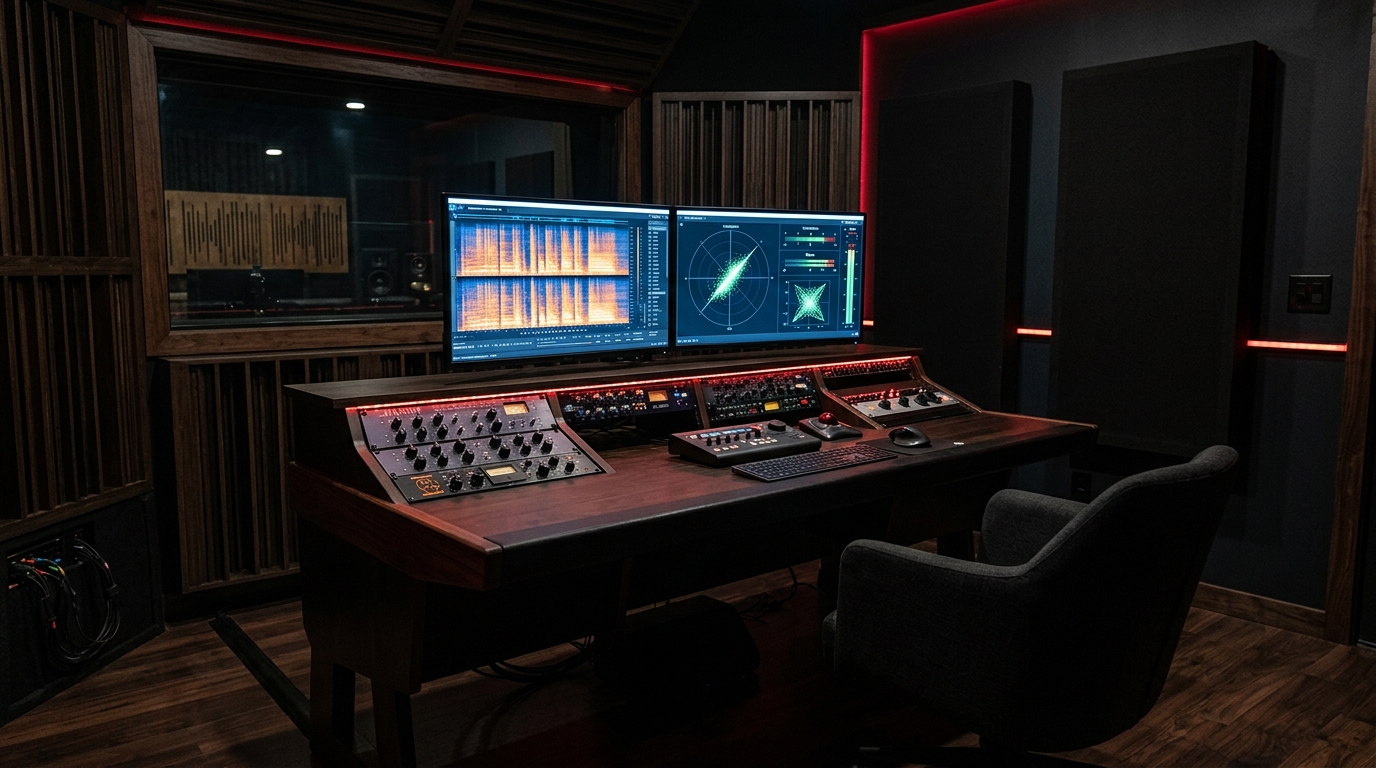
The mastering engineer listens in an acoustically perfected, calibrated listening room using ultra-flat full-range monitoring speakers capable of reproducing true bass down to 20Hz. Their job is objective quality control, sonic optimization, and format delivery.
The Mastering Workflow:
[Single Stereo WAV File from Mixdown]
      │
      ├──> Surgical Corrective EQ (Linear-phase curve smoothing)
      ├──> Subtle Multi-Band Dynamics / Glue Compression
      ├──> Stereo Imaging & Monomaker Calibration (<90Hz Mono)
      ├──> Harmonic Analog Saturation & Soft Clipping
      ├──> True Peak Brickwall Limiting (Loudness Maximization)
      ├──> Metadata, ISRC Tagging & Multi-Platform Encoding
      │
      ▼
[Streaming-Ready Master (Spotify, Apple Music, Tidal, Club, Vinyl, CD)]
What a Mastering Engineer Actually Does:
- Tonal Balance & Spectral Smoothing: Ensuring the track has the right amount of sub-bass, warm midrange, and sparkling treble so it sounds balanced whether played on a $50 Bluetooth pill speaker or a $100,000 festival line-array sound system.
- Competitive Commercial Loudness: Utilizing soft clippers and pristine brickwall limiters to raise the perceived loudness to commercial standards (e.g. -8 to -10 LUFS integrated for modern hip-hop/pop) without introducing audible distortion or squashing dynamic punch.
- Stereo Field and Phase Verification: Ensuring the low-end below 100Hz is perfectly mono-compatible and checking phase correlation meters across the stereo spectrum.
- Album Cohesion: If working on an EP or album, the mastering engineer ensures that Track 1 and Track 8 sound like they belong on the exact same project with consistent volume, tonal balance, and track spacing.
- Technical Delivery: Encoding ISRC metadata, setting true-peak ceilings to avoid inter-sample clipping during lossy MP3/AAC compression, and delivering platform-specific masters (Apple Digital Masters, CD DDP images, Vinyl cutting specs).
The mastering process is 70% technical and 30% creative. It is the final polish that gives a track its commercial sheen and structural durability.
3. The Dangerous Myth: "We Can Fix That in Mastering"
Every audio engineer has heard the dreaded phrase: "The vocal is a little quiet and the snare is too harsh, but don't worry, the mastering engineer will fix it."
No, they cannot.
Because the mastering engineer only has access to a single stereo audio file, their adjustments affect everything simultaneously:
* If the mastering engineer boosts 3kHz to make a dark lead vocal brighter, they also boost the high-hats, snare top, and electric guitars, making the entire track aggressively harsh.
* If the mastering engineer boosts 50Hz to bring out a weak 808 bass, they also boost the kick drum sub, causing the entire low end to clip into muddy distortion.
* If the lead vocal is 4dB too quiet in the mix, the mastering engineer cannot simply turn the vocal fader up. The vocal fader no longer exists.
The Law of Audio Production:
---------------------------------------------------------------------
Great Recording  +  Great Mix   +  Great Master  =  Platinum Record
Mediocre Record  +  Great Mix   +  Great Master  =  Good Record
Bad Recording    +  Bad Mix     +  Great Master  =  Loud, Polished Garbage
---------------------------------------------------------------------
Mastering is a magnifying glass. It magnifies the greatness of a great mix,
and it magnifies the flaws of a terrible mix.
Engineer Tip: If you are not 100% happy with the balance, energy, and vocal presence of your song in the rough mix, do not send it to mastering. Fix the problems at the source in the multitrack mixing session.
4. Feature Comparison: Mixing vs Mastering at a Glance
To keep the differences crystal clear, here is a breakdown of the two stages side-by-side:
| Feature | Mixing Stage | Mastering Stage |
|---|---|---|
| Input Files | 20 to 100+ separate multitrack audio stems | Exactly 1 stereo WAV file |
| Primary Goal | Balance, separation, spatial depth, emotion | Tonal balance, translation, loudness, quality control |
| Vocal Adjustments | Can automate faders, tune pitch, de-ess, add delay | Cannot isolate or adjust vocal fader independently |
| Reverb / Delays | Added creatively to individual tracks and aux sends | Never added (unless fixing extreme stereo defects) |
| Listening Environment | Creative studio environment | Acoustically tuned, ultra-flat mastering suite |
| Output File | Single unmastered stereo mixdown (-6dB peak headroom) | Final commercial master (-0.5dB to -1.0dB True Peak) |
5. Which Service Do You Actually Need Right Now?
How do you decide what service to book for your project? Use this decision checklist:
You Need Mixing & Mastering If:
- You recorded vocals over an instrumental beat, or tracked instruments in your DAW, and you have the raw audio tracks/stems.
- Your vocals feel buried, muddy, dry, or disconnected from the beat.
- You need vocal tuning (Melodyne / Auto-Tune), timing alignment, and breath cleanup.
- The song does not sound finished, cohesive, or exciting.
You Need Mastering Only If:
- You already paid a professional mixing engineer, and they delivered a clean, balanced, unmastered 24-bit stereo WAV with plenty of headroom.
- You love the balance of the vocal, drums, and instruments in your rough mix, but the track simply sounds quieter and slightly less bright compared to commercial Spotify songs.
- You are compiling a 5-track EP or 10-track album and need all the songs to match each other in volume and tonal consistency.
Frequently Asked Questions (Community Q&A)
Can mastering fix a vocal that is too quiet in the mix?
No. Because mastering operates on a single stereo file, any EQ boost applied to the vocal frequency range also boosts every instrument sharing that spectrum (snare, guitars, synths). While mid-side dynamic EQ can sometimes nudge the center channel up by half a decibel, it cannot rescue a vocal that was mixed too quietly. The only proper solution is to open the multitrack session and adjust the vocal fader.
Is AI mastering (like LANDR, eMastered, or Ozone Assistant) good enough compared to a human engineer?
AI mastering algorithms analyze frequency curves and apply automated multiband compression and limiting based on generic genre profiles. They are adequate for quick, low-budget demo references or rough SoundCloud uploads. However, AI algorithms cannot listen musically: they cannot tell if a vocal has emotional sibilance, they cannot detect subtle phase cancellation in car cabins, and they cannot make subjective artistic judgments about dynamic breathing. A seasoned human mastering engineer listens to the intent of the record and tailors the processing specifically to your mix.
How much headroom should I leave on my mix before sending it to mastering?
Aim for your loudest peak to hit between -6dB and -3dB True Peak on your master channel meter, with zero limiters or maximizers active on the master bus. Leaving 3dB to 6dB of clean digital headroom ensures the mastering engineer’s analog-modeled EQs, compressors, and clippers have sufficient dynamic space to sculpt the transient profile without clipping.
References & Authoritative Reading
Expand your technical foundation on the dividing line between multitrack mixing and stereo mastering with these industry resources:
- Audio Engineering Society (AES): Technical Recommendations for Audio Mastering — Industry whitepaper on loudness targets, inter-sample peaks, and master delivery.
- iZotope Audio Learning Hub: What is Mastering and How Does It Differ From Mixing? — Comprehensive architectural breakdown of the two distinct engineering stages.
- Sound On Sound: Preparing Your Mix for the Mastering Engineer — Essential checklist on headroom, bit depth, stem delivery, and master bus processing.
- Abbey Road Studios Education: The Evolution of Mastering in Modern Music — Historical perspective on vinyl lacquer cutting to modern high-resolution digital mastering.
Ready to Give Your Music Professional Treatment?
Whether you need a complete ground-up multitrack mixdown with vocal tuning and spatial depth, or a final commercial master that hits with radio-grade power:
👉 Explore My Audio Samples to hear before/after mixing and mastering transformations across Hip-Hop, Trap, and Pop.
👉 Book a Mixing & Mastering Session and let’s make your next release sound its absolute best.

Want This Level of Clarity on Your Next Release?
Don't let a flat mix bury your songwriting. Let's dial in the punch, vocal warmth, and radio-ready loudness your track deserves.